Best Dog Grooming Tools for Every Coat Type (2026)
Updated 2026 · 10 min read · 8 products reviewed
Affiliate Disclosure: PawCraftDen is reader-supported. As an Amazon Associate, we earn from qualifying purchases at no extra cost to you.
Shedding season can turn a clean living room into a fur-covered mess within hours, but the right grooming tool — matched to your dog's specific coat type — makes a dramatic difference in how much loose hair ends up on your floors versus contained in a brush. Double-coated breeds, short-haired heavy shedders, and long-haired dense coats each respond differently to rakes, slicker brushes, and deshedding tools, and using the wrong tool can leave undercoat trapped or, worse, irritate skin. The AKC's expert grooming and care advice emphasizes that regular, gentle brushing suited to coat type supports skin health, not just appearance. This guide breaks down which tools work for which coats, what safety considerations matter most, and how to build a grooming routine that actually keeps pace with your dog's shedding cycle.
| Product | Best For | Key Feature | Top Con | Link |
|---|---|---|---|---|
| Maxpower Planet Pet Grooming Rake Double-Sided | Best Overall Grooming Rake | Double-sided design covers two coat tasks | Less effective on curly or wiry coats | Jump to → |
| Swihauk Self Cleaning Slicker Brush Deshedding Tool | Best for Easy Cleanup | Retractable bristles with one-touch cleaning | Mechanism needs occasional cleaning | Jump to → |
| Docrok Pet Grooming Combo Deshedding Brush with Metal Comb | Best Grooming Combo Kit | Brush and metal comb in one set | Comb teeth tight for very thick coats | Jump to → |
| FURminator Large Dog Undercoat deShedding Tool Short Hair | Best for Short Hair | Stainless edge reaches deep undercoat | Premium price versus generic rakes | Jump to → |
| MIU COLOR Pet Grooming Brush Deshedding Tool | Best Value Brush | Budget-friendly everyday deshedding | Less durable than premium tools | Jump to → |
| FURminator deShedding Tool Medium Large Cats Long Hair | Best for Long Hair | Edge spacing suited to long dense coats | Needs regular use for results | Jump to → |

Maxpower Planet Pet Grooming Rake Double-Sided
A double-sided rake that handles both undercoat thinning and surface detangling in one tool.
Considerations
- Less effective on very curly or wiry coats
- Teeth can pull if used too aggressively
- Two-sided design covers two coat tasks
- Rounded teeth protect skin during use
- Comfortable non-slip handle
- Works well on medium-to-long coats

Swihauk Self Cleaning Slicker Brush Deshedding Tool
A retractable-bristle slicker brush that releases trapped fur with a single button press.
Considerations
- Retraction mechanism needs occasional cleaning
- Not ideal for heavily matted coats
- Button retracts bristles for one-touch cleaning
- Fine pins lift loose fur without scratching
- Ergonomic handle reduces wrist fatigue
- Works on most coat lengths

Docrok Pet Grooming Combo Deshedding Brush with Metal Comb
A multi-tool set pairing a deshedding brush with a fine metal comb for full-coat maintenance.
Considerations
- Comb teeth are closely spaced for very thick coats
- Storage case not included
- Two complementary tools in one purchase
- Metal comb catches fine tangles missed by brushes
- Comfortable cushioned grips
- Suitable for multiple coat types

FURminator Large Dog Undercoat deShedding Tool Short Hair
A purpose-built deshedding tool that reaches deep into short, dense undercoats.
Considerations
- Premium price point versus generic rakes
- Not designed for long or curly coats
- Stainless edge reaches deep undercoat fur
- FURejector button clears the blade easily
- Ergonomic handle suits longer sessions
- Sized for large short-haired breeds

MIU COLOR Pet Grooming Brush Deshedding Tool
An affordable deshedding brush that delivers solid everyday performance for most coat types.
Considerations
- Less durable than premium-tier tools
- Best suited to lighter shedding needs
- Budget-friendly without skipping core function
- Comfortable grip for everyday use
- Effective on light-to-moderate shedders
- Compact size for easy storage

FURminator deShedding Tool Medium Large Cats Long Hair
A long-hair-specific deshedding edge designed to manage dense, flowing undercoats without cutting topcoat.
Considerations
- Premium pricing compared to generic combs
- Requires regular use to maintain results
- Edge spacing suited to long, dense coats
- FURejector button for quick cleanup
- Reduces loose-hair shedding around the home
- Comfortable extended-use handle
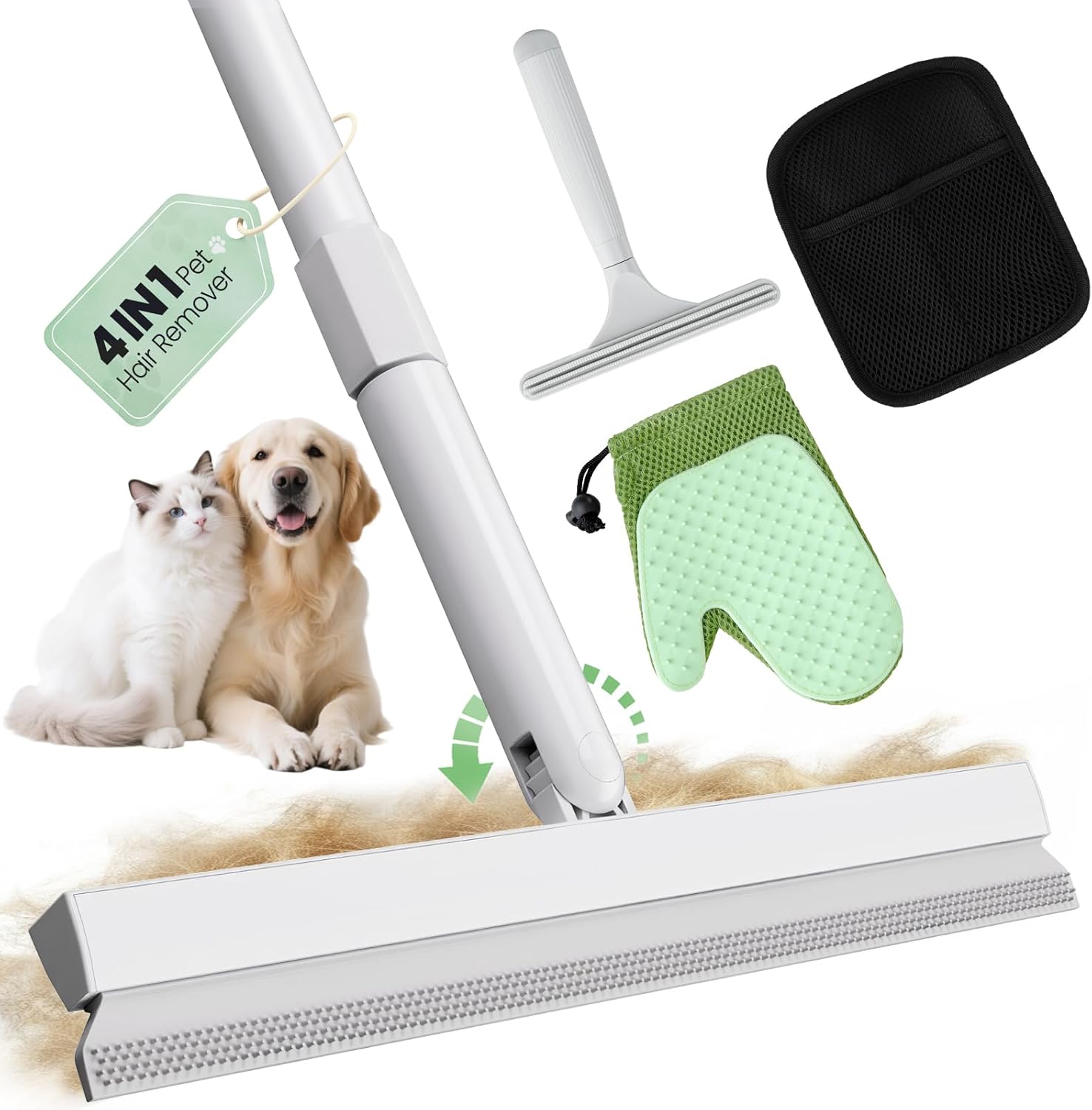
PWBSLAI 4-in-1 Carpet Rake Pet Hair Removal Kit
A four-piece kit — 60-inch rubber broom, grooming glove, magic brush, and scraper — for clearing shed fur from floors and furniture.
Considerations
- Rubber broom struggles on very deep-pile carpet
- Four pieces to store rather than one tool
- Adjustable 60-inch handle spares your back on carpets
- Rubber bristles lift embedded fur static-free
- Glove and brush handle upholstery and pet-side grooming
- Squeegee edge doubles for liquid cleanup on hard floors
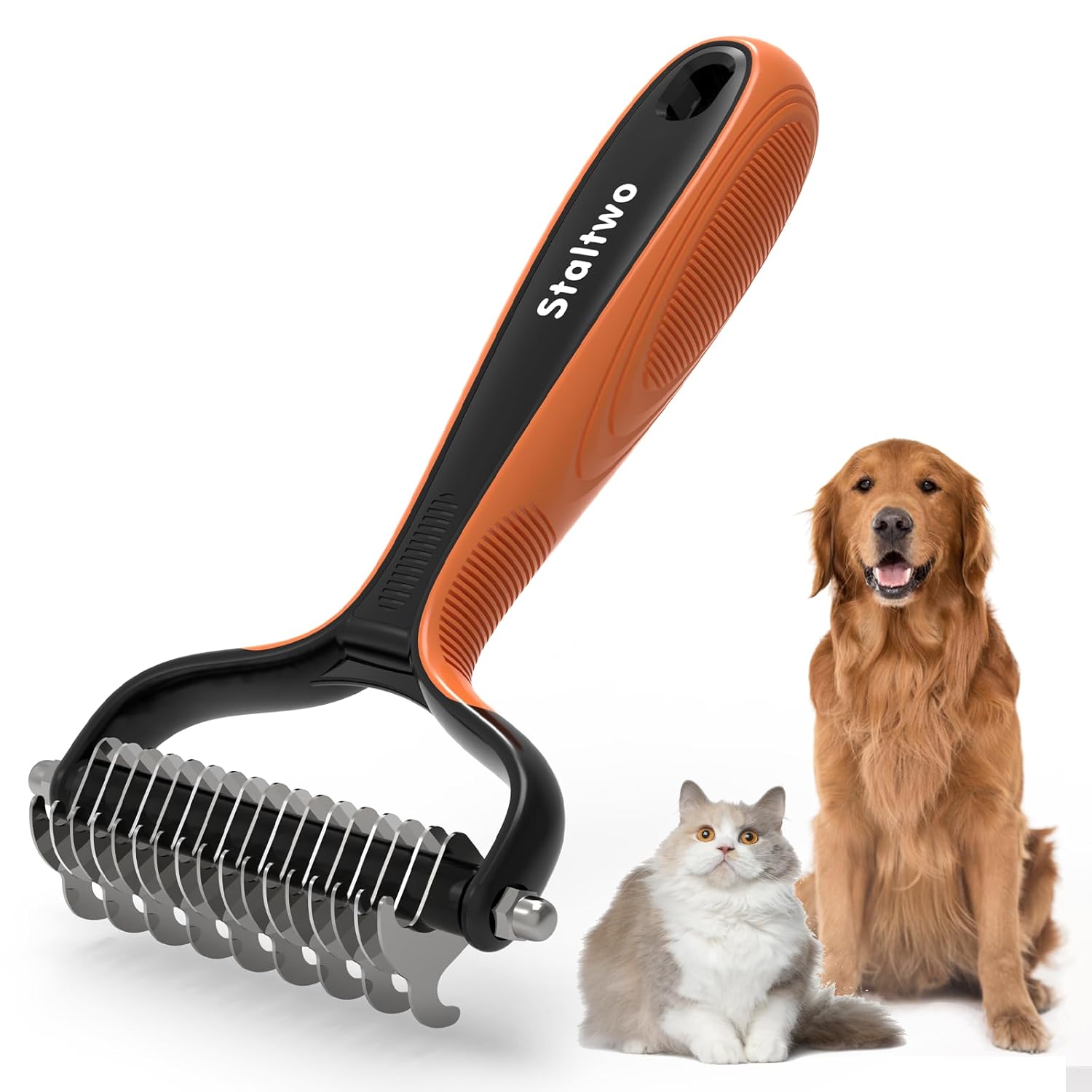
Staltwo Extra-Wide Deshedding Undercoat Rake
An extra-wide, double-sided undercoat rake that speeds up deshedding passes on long and medium coats.
Considerations
- Wide head is awkward around legs and face
- Overlaps in purpose with standard-width rakes
- Extra-wide head covers more coat per stroke
- Dense side thins undercoat, sparse side breaks knots
- Rounded stainless teeth are gentle on skin
- Bright orange handle is hard to misplace
Buying Guide
Grooming tools are not one-size-fits-all, and the difference between a tool that works beautifully and one that pulls, scratches, or simply fails to reach the undercoat often comes down to matching tooth spacing and bristle type to your dog's specific coat. Below, we cover coat-type fit, build quality and durability, safety on skin, and the practical question of how grooming routine and frequency should shape your purchase.
Matching Tools to Coat Type
Coat type is the single biggest factor in choosing a grooming tool, and it's worth understanding the three broad categories most dogs fall into. Short, dense double coats — think Labrador Retrievers, German Shepherds, and similar breeds — shed a fine, compact undercoat that sits close to the skin and is notoriously hard to remove with a standard brush. Purpose-built undercoat deshedding tools, with a stainless steel edge designed to reach beneath the topcoat without cutting skin, are far more effective here than generic rakes, since they're calibrated to pull loose undercoat without damaging the guard hairs above it.
Long-haired, dense-undercoat breeds like Huskies, Collies, and Golden Retrievers need a different approach. Their longer topcoat means standard short-hair tools can snag or skip over mats rather than working through them, so tools with wider tooth spacing calibrated for longer fur — sometimes labeled specifically for long-hair use — clear loose undercoat without yanking on healthy hair attached at the root. A two-sided rake is a versatile middle-ground option for many medium-to-long coats, since one side can handle detangling while the other focuses on undercoat removal, covering two grooming tasks without needing two separate tools.
Curly and wiry coats — Poodles, Doodles, terriers — are a special case that most rakes and deshedding tools struggle with, since these coat types trap shed hair within tight curls rather than releasing it the way straight or double coats do. These breeds generally benefit more from regular professional grooming combined with a slicker brush for light maintenance, rather than from deshedding tools designed primarily for shedding double coats.
Tip:If you're unsure which category your mixed-breed dog falls into, examine the undercoat by parting the fur near the shoulder blades — a dense, downy layer beneath the visible topcoat signals a double coat that will benefit most from a dedicated deshedding tool.
Build Quality and Durability
Grooming tools see repeated friction and pressure, so build quality directly affects both how long a tool lasts and how comfortable it is to use during longer sessions. Stainless steel teeth or blades resist bending and corrosion far better than coated plastic alternatives, and a well-finished edge stays sharp enough to glide through undercoat without snagging across many sessions. Handle ergonomics matter just as much as the working edge — a non-slip, cushioned grip reduces hand fatigue during longer grooming sessions, which matters most for larger dogs or heavier-shedding breeds that need more total brushing time per session.
Self-cleaning mechanisms, where a button retracts the bristles for easy cleanup, add convenience but also introduce a moving part that can collect hair and debris over time if not cleaned regularly. These tools are worth the investment for owners who groom frequently and want to minimize the mess of pulling trapped fur out by hand, but they do require occasional maintenance to keep the retraction mechanism working smoothly. Fixed-bristle brushes, by contrast, have fewer moving parts to maintain but require more manual effort to clear trapped hair after each use.
Premium deshedding tools with a built-in ejector button that releases collected fur in one motion save real time during heavy shedding seasons, since manually picking collected undercoat out of fine teeth can take longer than the actual brushing. Budget tools without this feature still get the job done but ask for more patience between passes. For dogs with light to moderate shedding needs, the durability gap between budget and premium tools matters less, since the tool sees lighter overall use.
Safety on Skin
Even though grooming tools are designed to remove loose hair rather than cut skin, improper technique or the wrong tool for a coat type can cause real irritation, especially on dogs with sensitive skin or thin coats around the belly, ears, and legs. Rounded, protected tips on rake and comb teeth reduce the risk of scratching the skin surface during use, and using light, consistent pressure rather than aggressive pulling motions prevents over-brushing that can lead to redness or small abrasions.
Deshedding tools with a sharp stainless edge are particularly effective at reaching undercoat, but that same effectiveness means they should be used with a lighter hand than a standard brush, following the direction of hair growth rather than against it. Watch for any signs of skin redness, flaking, or your dog flinching during a session — these are signals to ease up on pressure or switch to a gentler tool for that area. The AVMA's pet care guidance recommends stopping immediately if a dog shows pain responses during grooming and consulting a veterinarian if skin irritation persists beyond a day or two.
Tip:Avoid using deshedding rakes or undercoat tools directly over bony areas like the spine, hips, or shoulder blades where there's less padding between skin and tool — switch to a softer slicker brush in these spots.
Grooming Frequency and Routine
How often you groom should influence which tool you buy, since tools built for daily light maintenance differ meaningfully from those designed for intensive seasonal deshedding sessions. Dogs with heavy double coats typically need two to three sessions per week during peak shedding seasons (spring and fall) and can drop to once weekly during the rest of the year. For these dogs, investing in a purpose-built deshedding tool with an ejector button pays off quickly in time saved, since heavy seasonal sessions can otherwise take considerably longer with a basic brush.
Dogs with lighter shedding patterns or shorter, single-layer coats can often get by with a simple, affordable brush used once or twice weekly for general coat health and to catch loose hair before it ends up on furniture. In these cases, spending extra on a premium deshedding tool offers diminishing returns, since the coat itself doesn't produce the dense undercoat buildup that justifies the more aggressive tool design.
Whatever frequency you settle on, consistency matters more than intensity — regular shorter sessions prevent mats and tangles from forming in the first place, which is considerably easier on both you and your dog than working through an already-matted coat. Pairing a good brush with a calm routine, ideally after a walk when your dog is relaxed, also reduces resistance and makes grooming sessions shorter and more pleasant for everyone involved.
Grooming pairs naturally with broader at-home dog care routines. If shedding season also means more loose hair near the mouth and paws, a look at dental care chews can help round out a full care routine, while a well-fitted harness makes it easier to keep a wriggly dog still during brushing sessions outdoors. For dogs prone to anxiety during grooming, a calming vest worn before a session can help ease nervous dogs into the process.
Choosing the right grooming tool ultimately comes down to honestly assessing your dog's coat type and your own willingness to maintain a regular brushing schedule. A well-matched tool used consistently will do more for coat health and shedding control than an expensive tool used sporadically, so prioritize fit over features when narrowing down your options.
Frequently Asked Questions
Double-coated breeds generally benefit from two to three brushing sessions per week, increasing during spring and fall shedding seasons, while short single-coat breeds often do fine with once or twice weekly brushing for general coat health.
Further Reading
Affiliate Disclosure: Links on this page may earn PawCraftDen a commission as an Amazon Associate.